Brand Design Evaluation
Introduction
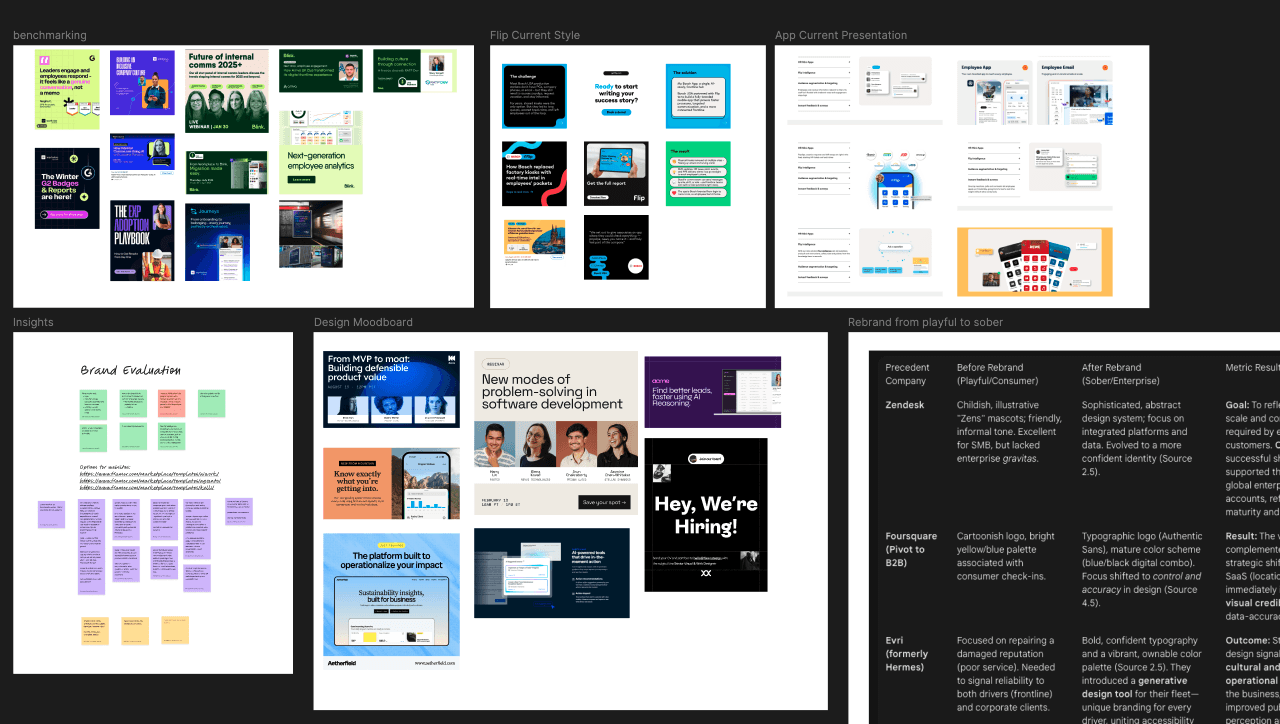
This evaluation is grounded in established brand positioning research and competitive benchmarking, not subjective opinion. My methodology draws from:
Growth-Focused Brand Frameworks: Measuring brand equity through perception scores, message retention, and purchase intent.
Competitive Benchmarking: Analysis of successful brand positionings, studying how companies like Slack, Zendesk, Atlassian, and Notion evolved their visual systems to serve dual audiences.
After talking to mentors who fit our target audience as decision-makers, I realized that brand differentiation is more important than brand alignment in B2B segments. Moreover, hyper-personalization is a good strategy for AI-native products, as we can have multiple expressions of the same brand, with consistency.
What Works Well
1. Strong Color Ownership Potential
The primary blue (#2151F5) is distinctive and energetic. Color psychology shows that brands with strong 1-2 color identities (Spotify green, Stripe purple, IBM blue) achieve higher brand recall in competitive categories. Flip has the foundation for it.
2. Dual Sub-Brand Architecture
The Flip Intelligence branding provides a sophisticated counterpoint to the friendly and playful main brand. This mirrors Atlassian's successful approach, using Jira (playful) vs. Trello (professional) to serve different contexts while maintaining master brand coherence.
3. Photography System
The way frontline workers images were developed creates immediate emotional connection, and Flip's current efforts around video creation with AI are outstanding.
What Can Be Improved
1. No Visual Hierarchy for Dual Audiences
The same playful elements (full secondary palette, Meeple characters, bright compositions) appear across all contexts. Use playful elements with intent and hierarchy: reserve Meeples and full color palette for contexts where they drive adoption (frontline-facing materials), while introducing more refined expressions (strategic color accents, geometric Intelligence icon system) for contexts requiring authority signals (pitch decks, ADS, website). Modern VPs respond to brands that are confident and human, but they need visual proof that the platform can handle complexity.
Benchmark: Zendesk's brand evolution strategically contained playful elements to user-facing contexts while refining executive materials, contributing to enterprise conversion growth.
2. Colors Used for Decoration, Not Strategic Contrast
Secondary colors (green, yellow, red, purple) lack functional hierarchy. To achieve a premium brand perception, we can develop minimalist interfaces with single strategic accents.
3. Missing Visual Proof of Flip Intelligence
The brand shows communication (Meeples, chat) but not Flip intelligence (data flow, system architecture, ML connections). The Flip Intelligence brand exists but isn't leveraged to visualize the platform's core differentiation: "unified ML model connecting brand to performance." Visual representations in B2B marketing of abstract technical value significantly improve message retention and differentiation.
Improvements
1. More Enterprise-Ready: Implement Audience-Tiered Brand Expression
The Change: Create distinct visual tiers based on audience context:
Frontline-facing (app, internal): Full palette, Meeples, high energy
Executive-facing (pitch decks, white papers, website, marketing design): color palette from Flip Intelligence, Intelligence icon, minimal strategic accents
Measurement: Track conversion rates from executive-facing materials. A/B test current materials vs. tiered expression approach with X prospects, measure advancement to next sales stage.
2. More Premium: Strategic Color Containment System
The Change: For executive materials, restrict secondary colors to "small interventions":
Create light and dark modes: A/B test with target personas
One strategic accent per composition (yellow dot after key metric, green on ROI, etc)
Colors become functional data highlights, not decoration
Monochromatic palettes with single strategic accents increase premium positioning perception.
Measurement: A/B test Ads and posts with target personas, compare purchase intent scores.
3. More Confident & Modern: Elevate Intelligence Icon as Visual Proof System
The Change: Build a geometric graphic system using the Flip Intelligence icon to visualize:
Data flow (frontline input → ML → executive insights)
System architecture (unified platform connecting scattered tools)
Connection networks (departments/locations linked through Flip)
Use icon geometry with gradients on dark backgrounds. Animate for demos showing real-time data movement.
Cognitive research on visual metaphors and brand storytelling shows that tangible visual representations of abstract value significantly improve message retention and product differentiation. Makes abstract "ML intelligence" value concrete and memorable.
Measurement: Test message retention: after viewing materials, measure unprompted recall of Flip's core differentiation ("intelligence/unified platform" vs. "employee communication app").
Conclusion
These improvements create scalable brand architecture that maintains Flip's authentic, people-first positioning for frontline users while introducing visual authority for enterprise buyers. The brand becomes a strategic tool that adapts contextually: playful where it should be, powerful where it must be.
What sets Flip apart: A brand that practices the hyper-personalization it sells, intelligently differentiating for fundamentally different audiences without dilution.